From CoEvolution
Magazine, No. 35, Fall 1982 From CoEvolution
Magazine, No. 35, Fall 1982
Honest Hope
by Anne Herbert
I've been thinking about honest hope.
When we start to hope often we promise ourselves too much.
If this one thing changes, we say, then it will all change -
injustice disappear and no more lonely days, lonely nights, for
anyone, for me.
The war ends, we/they get the vote, waking up each day stays
too much the same, people find new ways to steal joy from each
other.
Give up, hide, lost dreams turn to headaches because we refuse
to cry.
If we started with honest hope, could we go farther do you
think? What would honest hope be like? What can we honestly hope
for?
Time. The lie often has to do with too soon. The hopeless
(lazy) say, "It'll never happen," and the hopeful say,
"Yes, it will, and soon" - turning to the angry "NOW!"
Some of it does happen now, some never, but mostly it happens
some odd kin of not soon enough. Not soon enough for the hoping
workers to notice that it happened. They've given up or want
so much more it doesn't matter.
Percentages of a single lifetime may be too short for honest
hope to live in.
I don't know, words keep trying to fit together, honesty,
hope, seeds, garden, forest. Who'd have guessed a seed would
do that, get so large? To be alive you have to have the quick
seeds, tomatoes to plant and eat, and corn. Easy to remember,
if you remember to remember, that it was you that started this
good thing happening not long ago. But also we need to plant
the forests, and tend them, and leave space for them to tend
themselves.
Assembly line time, we're trapped in making things fast that
break fast and thinking that something has happened. That magic
moment, ablaze in television lights, praised in jingle and slogan,
when you stand in the store and buy the new doohickus, when you
believe it's going to make the difference, that moment is short.
Other moments, less famous, are longer. Kachunk, kachunk, I can't
wait to leave, where's oblivion -- moments of making the shiny
object go on a while, and there are many of them.
Then there's Christmas afternoon and it breaks. Even if it
doesn't break, or not as soon as Christmas afternoon, it doesn't
come close to touching your store hope. It doesn't change
things. That short hope breaks in the many moments of the thing
bored people made aging, but sometimes I don't notice because
I'm on to other hopes, the next great purchase.
Tree time. Tree time takes longer. Trees, when they grow up,
you don't think if you still like them. Your opinion is not the
point. Tree time takes learning in a group of people like us
where the rhythm of life has been determined (baba - boom, baba
- boom) by tightening ten lugs a minute and on to the next car.
If we're lucky we don't work there, but we measure our luck by
how many things we can buy that were made there, and how fast
we can buy them.
Pea pod time could teach you tree time. Fresh vegetables from
the garden take longer than "this factory turns out twenty
seven hundred gadgies an hour" and are part of a species
long love affair with your mouth, take a while to happen and
don't let you down. It's hard to remember how good they taste
and then they wake up green pleasure cells you didn't know you
had, the opposite of the third dent on the car and watching the
dust settle on the electric knife sharpener.
Growing stuff with curves might match time more than building
stuff with angles.
Honest hope and true time.
Real, slow-growing, long-lasting, hard-standing changes, like
trees, never come up and pat you on the head and say, "You
did it, kid, you made me possible, and you're terrific and I'm
grateful as hell."
Because: 1) you might be dead by the time they're big and
tall and you'll surely be different than when first hope caught
you; 2) something that substantial you weren't the only variable
that varied to make room for it; 3) trees and big changes aren't
interested in personalities, even yours.
Honest hope. Plan to get your warm fuzzies someplace else.
(What are friends for?) Hope that melts things and makes them
new is as huggable as a flame. But warm at the right distance.
The right uses of hope and the right distance. Get too close
to the campfire, you get blisters, you get wounds. Stare at the
flicker too long, you get crazy. Warm your butt and move it.
Get to work.
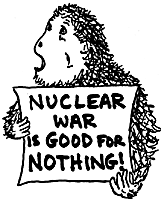
The Hundredth Monkey
From the book The Hundredth Monkey, by Ken Keyes,
Jr.
There is a phenomenon I'd like to tell you about. In it may
lie our only hope of a future for our species! Here is the story
of the Hundredth Monkey:
The Japanese monkey, Macaca fuscata, has been observed in
the wild for a period of over 30 years. In 1952, on the island
of Koshima, scientists were providing monkeys with sweet potatoes
dropped in the sand. The monkeys liked the taste of the raw sweet
potatoes, but they found the dirt unpleasant.
An 18-month-old female named Imo found she could solve the
problem by washing the potatoes in a nearby stream. She taught
this trick to her mother. Her playmates also learned this new
way and they taught their mothers, too.
This cultural innovation was gradually picked up by various
monkeys before the eyes of the scientists. Between 1952 and 1958,
all the young monkeys learned to wash sandy sweet potatoes to
make them more palatable. Only the adults who imitated their
children learned this social mprovement. Other adults kept eating
the dirty sweet potatoes.
Then something startling took place. In the autumn of 1958,
a certain number of Koshima monkeys were washing sweet potatoes
- the exact number is not known. Let us suppose that when the
sun rose one morning there were 99 monkeys on Koshima Island
who had learned to wash their sweet potatoes. Let's further suppose
that later that morning the hundredth monkey learned to wash
potatoes. THEN IT HAPPENED!
By that evening almost everyone in the tribe was washing sweet
potatoes before eating them. The added energy of this hundredth
monkey somehow created an ideological breakthrough!
 But notice. The most surprising thing observed by
these scientists was the habit of washing sweet potatoes then
spontaneously jumped over the sea. Colonies of monkeys on other
islands and the mainland troop of monkeys at Takasakiyama began
washing their sweet potatoes! Thus, when a certain critical number
achieves an awareness, this new awareness may be communicated
from mind to mind. But notice. The most surprising thing observed by
these scientists was the habit of washing sweet potatoes then
spontaneously jumped over the sea. Colonies of monkeys on other
islands and the mainland troop of monkeys at Takasakiyama began
washing their sweet potatoes! Thus, when a certain critical number
achieves an awareness, this new awareness may be communicated
from mind to mind.
Although the exact number may vary, the Hundredth Monkey
Phenomenon means that when only a limited number of people
know of a new way, it may remain the consciousness property of
these people.
But there is a point at which if only one more person tunes
in to a new awareness, a field is strengthened so that this awareness
reaches almost everyone!
Whatever that critical number is, you are needed to save our
civilization.
That quote is from an easy to read, profound, cheap book about
making the difference that stops the wars. The Hundredth Monkey,
by Ken Keyes, Jr. (1981; from Vision Books, St, Mary,
KY 40063 or the Whole Earth Household Store). - Anne Herbert

|